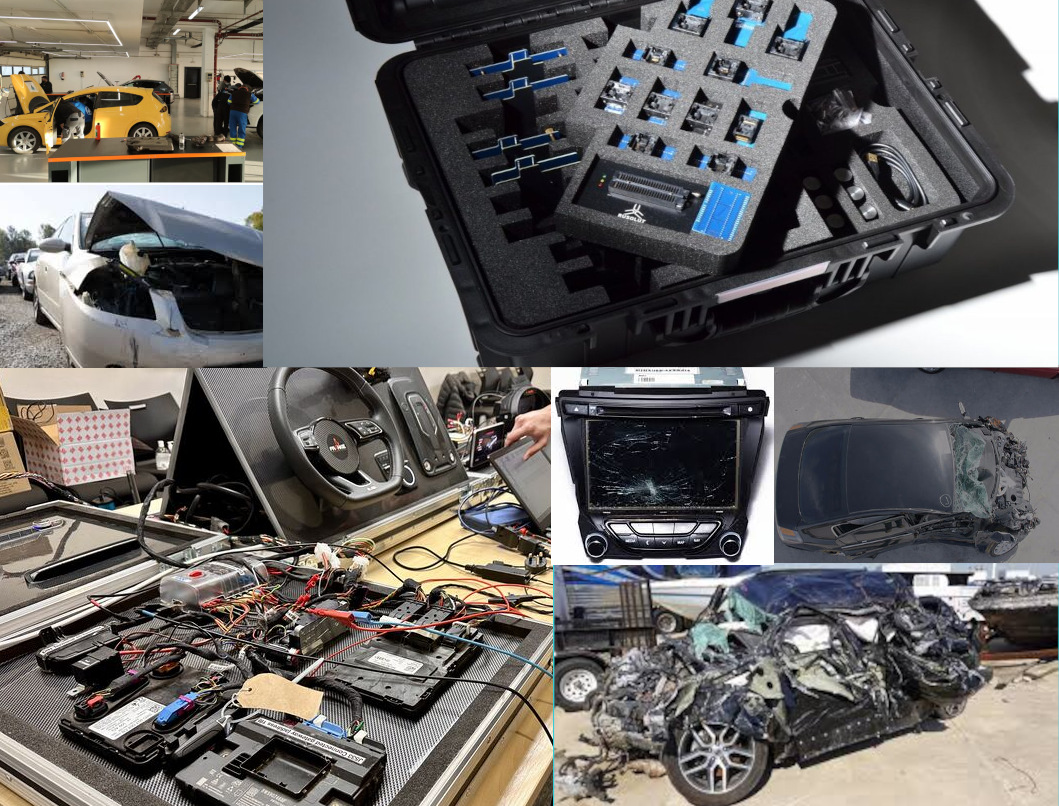
Vehicle data recovery is a car infotainment & telematics system data recovery that involve extracting and analyzing digital data, often evidence from modern vehicles to reconstruct events, determine liability, and investigate crimes. Using specialized tools like Vehicle Data Reconstructor, Berla iVe and others, technicians recover data from infotainment systems, telematics, and Event Data Recorders (EDRs), including GPS locations, speeds, braking, and paired devices. We previously covered data recovery from Tesla.
In the world of digital forensics, we’ve officially moved past the “laptop and smartphone” era. Today, the most sophisticated witness at a crime scene might actually be parked in the driveway.
Modern vehicles are essentially high-performance data centers wrapped in steel and glass. For a forensic examiner, this means a shift from analyzing file systems to interrogating real-time networks and high-voltage hardware. Here is a deeper dive into Vehicle Systems Forensics (VSF) from a data recovery perspective.
Vehicle Network Communication
To recover data from a car, you first have to understand how its “brain” talks to its “limbs.” This happens via several specialized protocols, each serving a distinct purpose.
CAN (Controller Area Network)
The CAN Bus is the backbone of automotive communication. It’s a broadcast-based system where every Electronic Control Unit (ECU) “shouts” its status to the rest of the car. By tapping into the CAN bus (often via the OBD-II port), an investigator can live-log telemetry like steering angle, brake pressure, and throttle position. Most modern cars now use CAN-FD (Flexible Data Rate), which allows for larger data payloads. Recovery often involves parsing massive .pcap or .asc logs to reconstruct an event timeline.
LIN (Local Interconnect Network)
LIN is the “budget” network. It’s used for low-speed, non-critical tasks like adjusting power seats, mirrors, or climate control. While often overlooked, LIN logs can prove occupant behavior. Did the driver adjust their seat right before the crash? Was the window rolled down? This granular data lives here.
FlexRay
FlexRay is used for safety-critical systems like “drive-by-wire” steering and active suspension. Unlike CAN, FlexRay is deterministic—it operates on a strict time schedule. Because FlexRay handles the most sensitive maneuvers, its data is highly reliable for accident reconstruction. However, it is notoriously difficult to “sniff” without specialized hardware that can sync with the network’s precise timing.
If the networks are the nervous system, the Infotainment (IVI) and Telematics units are the vehicle’s long-term memory. When a user pairs their phone, the car often ingests:
- Call Logs & SMS: Often stored in SQLite databases within the IVI’s flash memory.
- Location History: GPS “track logs” that show exactly where a vehicle has been, often dating back months.
- Device Metadata: Unique identifiers (MAC addresses, Bluetooth IDs) for every phone that ever connected.
Advanced Driver Assistance Systems (ADAS) includes cameras, LiDAR, and radar. Many modern vehicles (like Tesla or high-end Audis) store “event clips” when sensors detect a near-miss or impact. ADAS data is often volatile. In many systems, if the vehicle isn’t powered down correctly after an incident, the system might overwrite the most recent “pre-collision” video buffer.
High Voltage Systems Awareness (EVs/HEVs)For a forensic examiner, Electric Vehicles (EVs) aren’t just cars—they’re giant, potentially lethal batteries. High Voltage (HV) Awareness is a prerequisite for physical data recovery.
In the automotive world, orange cables mean “this will kill you.” These lines carry upwards of 400V to 800V DC.
HVIL (High Voltage Interlock Loop): This is a low-voltage safety circuit that runs through every HV connector. If a forensic examiner unplugged a module improperly, the HVIL could trigger a “pyro-fuse,” permanently “bricking” the car’s electrical system and potentially corrupting data.
Battery Management System (BMS): The BMS contains “freeze frame” data regarding the battery’s state of health, temperature, and discharge rates during an incident. Extracting this requires specialized PPE (Class 0 gloves) and insulated tools.
The Vehicle Data Recovery Workflow
The approach scales from “polite” to “invasive.
Logical Acquisition (The OBD-II Triage) – Using tools like Berla iVe or specialized OEM diagnostic software, we pull “logical” reports. This is non-destructive and gathers the “easy” stuff: VIN, mileage, and active trouble codes.
Physical Extraction (The Bench Exam) – When the car is too damaged to power on, we remove the ECUs. We connect directly to the circuit board via JTAG or ISP (In-System Programming). This allows us to “bit-stream” the entire memory chip, including deleted data.
Chip-Off Forensics – If the board is shattered, we desolder the memory chip (eMMC or NAND) entirely and place it in a chip reader. Warning: This is a one-way trip. Once you “chip-off” an IVI module, that car is likely never speaking again. But for data recovery, it’s the only way to ensure 100% of the raw data is captured.
An eMMC (embedded MultiMediaCard) is the “hard drive” of the car. It’s an integrated circuit that combines flash memory and a controller. In a present-era vehicle, this chip typically stores:
- Operating System: (Usually Automotive Grade Linux, QNX, or Android Automotive).
- User Data: GPS history, synced contacts, and even cached Spotify playlists.
- System Logs: The “black box” data of the IVI system.
Once the IVI module is disassembled, we locate the eMMC. It’s usually a BGA (Ball Grid Array) chip—meaning the “pins” are actually tiny balls of solder underneath the chip.
- The Challenge: Automotive boards are often built with heavy heat sinks and underfill (a tough epoxy injected under the chip to prevent it from vibrating loose while driving).
- Preparation: We apply heat-resistant Kapton tape to surrounding components (especially the CPU and RAM) to prevent them from “floating” away or getting damaged by the heat.
Using a professional SMD rework station, we apply focused heat (roughly 350°C to 400°C) and plenty of flux.
- The Critical Moment: If you use too much heat, you “pop” the chip (delamination), destroying the data forever. If you use too little, you rip the copper pads off the board.
- Removal: Once the solder reaches a liquid state, we use specialized tweezers to lift the chip vertically.
The chip comes off messy, covered in old solder and epoxy.
- Cleaning: We use a soldering iron and “wick” to smooth the bottom of the chip.
- Reballing: To read the chip, we place it in a stencil and apply fresh solder paste, then heat it again to create perfect new solder spheres. This ensures every pin makes contact with our reader.
We place the cleaned chip into a ZIF (Zero Insertion Force) Socket connected to a forensic bridge (like an Easy-JTAG or a specialized High-Speed eMMC Reader).
- Bit-for-Bit Imaging: We pull the entire raw binary (
.binor.img). At this stage, we aren’t looking at “files” yet—just 1s and 0s.
Once we have the image, the real work begins. Automotive systems don’t use Windows-style file systems. You’re likely to encounter:
- EXT4 / SquasFS: Common in Linux-based IVIs (Tesla, many European brands).
- QNX6 / QNX7: A proprietary real-time OS used by Ford, Chrysler, and many others.
- Proprietary Databases: Even if you can see the files, the GPS logs might be in a custom binary format that requires reverse-engineering.
Forensic Note on Encryption: Many high-end vehicles (like the latest Mercedes or Rivians) use File-Based Encryption (FBE) tied to a hardware-backed keystore in the CPU. If the chip is encrypted and the CPU is dead, a chip-off might yield nothing but gibberish. This is why “Chip-Off” is becoming “Chip-Swap” (moving the chip to a donor board) in modern vehicle data recovery labs.
